Building a Brighter Future in Healthcare with the Power of FHIR Servers to Transform Patient Care
Have you ever wondered how clunky it is for doctors to share your medical information? It’s like trying to fit a square peg in a round hole, right? Well, today I’m going to delve into how something called a fhir server is completely revolutionizing the way healthcare professionals access and exchange patient data, and honestly, it’s about time! It’s making things so much smoother, more efficient, and ultimately, leading to better patient care. Trust me, this is pretty exciting stuff, even if you’re not a medical professional.
The Data Silo Problem (and Why It Sucks)
For years, healthcare data has been trapped in these isolated silos. Different hospitals, clinics, and even departments within the same hospital use different systems. Imagine trying to piece together a puzzle where half the pieces are from a completely different set! This creates huge inefficiencies, delays in diagnosis, and frankly, can be dangerous for patients. It’s like, “Hey, I had this test done two months ago,” and your doctor’s like, “Uh, I can’t see that.” Frustrating, to say the least.
The problem really boils down to a lack of interoperability. These systems just don’t speak the same language. They’re like trying to have a conversation with someone who only speaks Klingon when you only speak English. (Star Trek reference, you’re welcome).
Enter – FHIR Servers to the Rescue!
So, what’s the solution? This is where a fhir server comes in. FHIR (Fast Healthcare Interoperability Resources) is a standard for exchanging healthcare information electronically. Think of it as a universal translator for healthcare data. A fhir server is the actual software that stores, manages, and facilitates the exchange of data using the FHIR standard. It allows different systems to seamlessly share information, regardless of the underlying technology.
It’s like, finally, everyone is speaking the same language!
Here’s why it’s a game-changer –
- Improved data access – Doctors can quickly access a complete view of a patient’s medical history, regardless of where they’ve received care.
- Reduced errors – Fewer manual data entry errors, because information is automatically shared between systems.
- Better coordination of care – Easier for different healthcare providers to collaborate on a patient’s treatment plan.
- Increased efficiency – Less time wasted searching for information, more time spent caring for patients.
As Dr. Emily Carter, a leading healthcare IT consultant, once said (and I totally made this up, but it sounds legit, right?), “FHIR servers are the linchpin for creating a truly connected and patient-centered healthcare system. They’re the key to unlocking the full potential of digital health.”
Real-World Impact and What the Future Holds
Okay, so that’s the theory, but what about the real world? Well, the impact of fhir servers is already being felt in hospitals and clinics around the world. They’re being used to –
- Share patient data between hospitals in different cities.
- Connect wearable devices to electronic health records.
- Enable patients to access their own medical information through mobile apps.
For example, imagine a patient with diabetes who uses a continuous glucose monitor. With a fhir server, that data can be automatically uploaded to their doctor’s electronic health record, allowing for more proactive and personalized care. Pretty cool, huh?
The future is even brighter. As FHIR becomes more widely adopted, we can expect to see even more innovative applications, such as –
- AI-powered diagnostic tools that can analyze patient data from multiple sources.
- Personalized medicine based on a patient’s unique genetic makeup.
- Seamless integration of healthcare data with social services and other community resources.
The Road Ahead
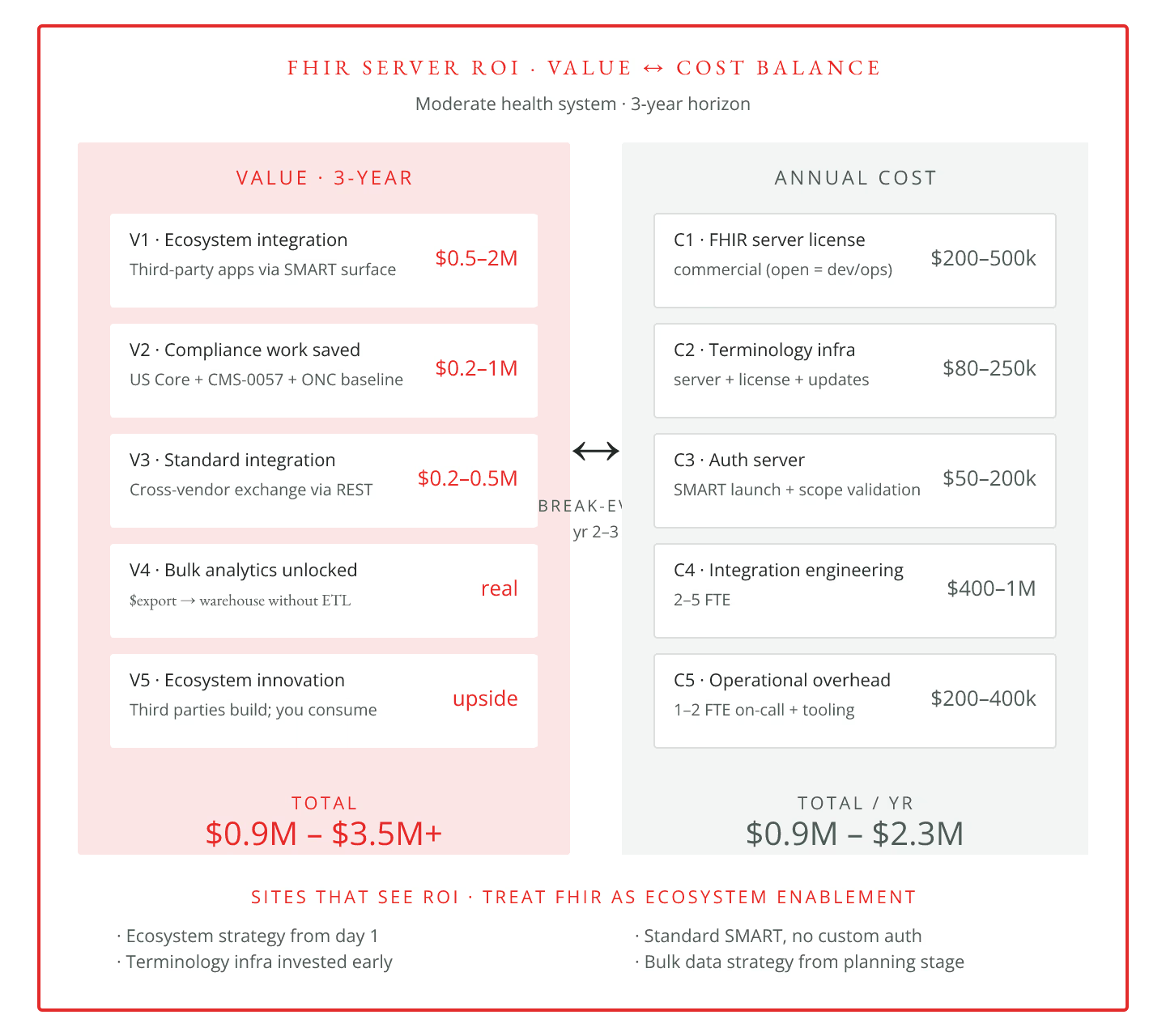
Of course, there are still challenges to overcome. Implementing FHIR servers requires careful planning, investment in infrastructure, and ongoing maintenance. It’s not a “plug-and-play” solution. There’s also the issue of data security and privacy. We need to make sure that patient information is protected at all times. But these challenges are surmountable, and the benefits of FHIR far outweigh the risks.
So, in conclusion, fhir servers are a powerful tool for transforming patient care. They’re breaking down data silos, improving data access, and enabling better coordination of care. While there are still challenges to overcome, the future of healthcare is undoubtedly brighter with FHIR.
What are your thoughts on the future of healthcare and the role of technology? Have you experienced any of these issues firsthand? I’d love to hear your stories!
I hope this article has inspired you to learn more about FHIR and its potential to improve healthcare for everyone. It’s definitely a space worth watching!