
FHIR Implementation Playbook: 7 Steps From Planning to Production
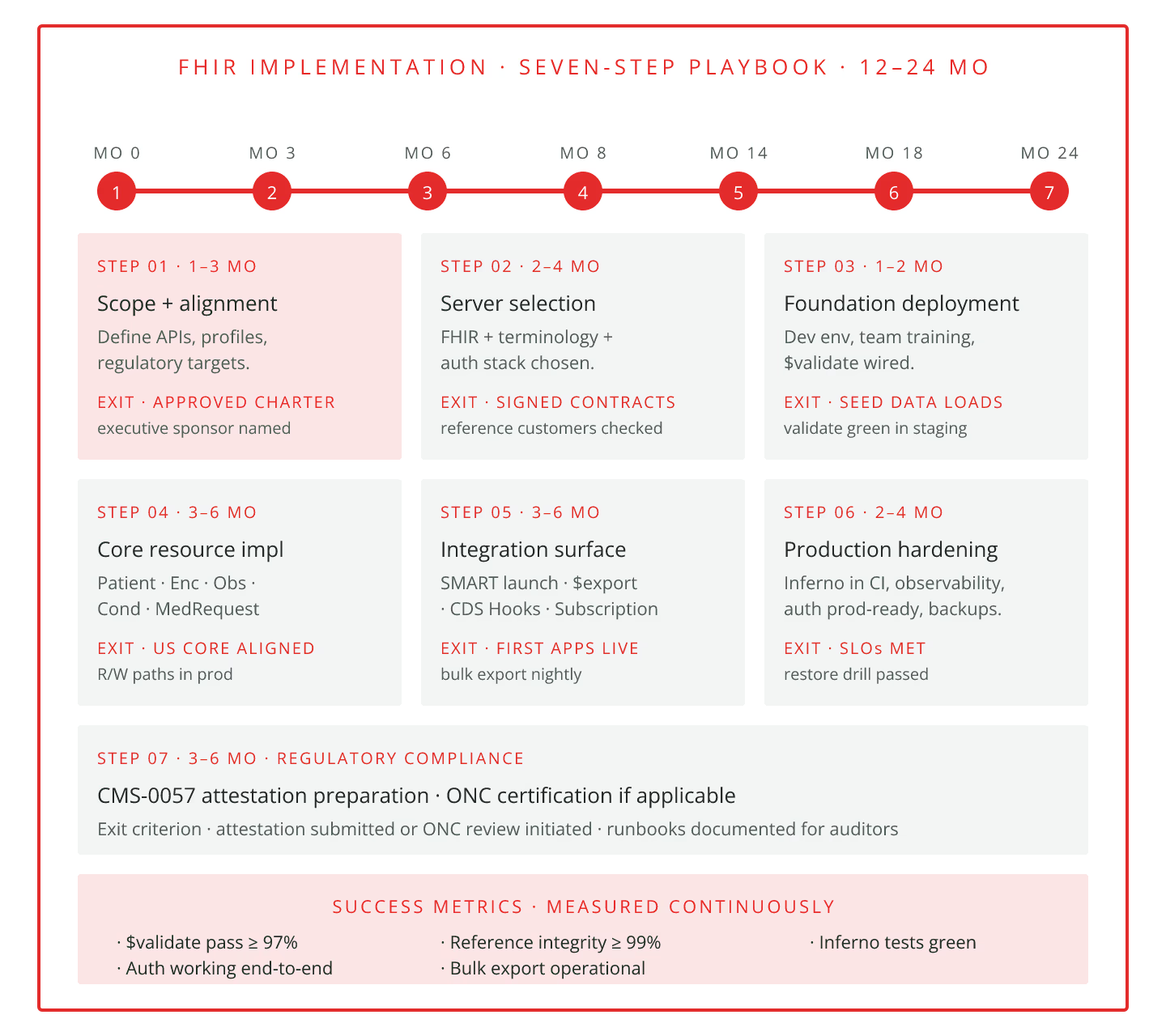
FHIR implementation follows a repeatable playbook. Seven steps cover essentially every production deployment.
Step 1: Scope and stakeholder alignment. Define what FHIR APIs, which profiles, which regulatory targets, which timeline. Executive sponsor and dedicated team.
Step 2: Server and infrastructure selection. Pick FHIR server, terminology server, auth server based on requirements. See vendor comparison.
Step 3: Foundation deployment. Dev environment; team training; initial resource loading; `$validate` wired.
Step 4: Core resource implementation. Patient, Encounter, Observation, Condition, MedicationRequest read/write paths. US Core conformance baseline.
Step 5: Integration surface delivery. SMART on FHIR launch, Bulk data $export, CDS Hooks as applicable.
Step 6: Conformance and production hardening. Inferno in CI; observability; auth production-ready; backup procedures.
Step 7: Regulatory compliance. CMS-0057 attestation preparation, ONC certification if applicable.
Timeline by step
| Step | Duration |
|---|---|
| Scope + alignment | 1-3 months |
| Server selection | 2-4 months |
| Foundation | 1-2 months |
| Core resources | 3-6 months |
| Integration surface | 3-6 months |
| Production hardening | 2-4 months |
| Regulatory compliance | 3-6 months |
| Total | 12-24 months |
Common execution mistakes
1. Skipping foundation (jumping to features). 2. Custom auth instead of SMART. 3. Deferring conformance testing. 4. No terminology infrastructure. 5. Manual bulk data.
Team composition (typical)
1. Executive sponsor (1). 2. Technical lead (1). 3. FHIR engineers (3-5). 4. DevOps (1-2). 5. Terminology admin (0.5). 6. Clinical informaticist (1).
Success metrics
1. $validate pass rate >97%. 2. Reference integrity >99%. 3. Inferno tests passing. 4. Auth working end-to-end. 5. Bulk export operational.
FHIR implementation is a solved discipline in 2026. Follow the seven-step playbook and ship reliably.