
Keeping Resource Order Stable Across Pretty-Printing
Pretty-printing a Bundle should change the whitespace and nothing else. That is the rule. Formatters that helpfully reorder keys, entries, or arrays are not helpful — they turn a formatting operation into a semantic change, and every downstream consumer that cared about the original order sees behavior drift. The site's FHIR JSON tidier preserves order by default and offers an explicit sort option when you want one. For the wider FHIR framing, the conecion healthcare data hub has more.
Two Kinds Of Order
- Key order — the order of fields inside a resource
- Array order — the order of entries in an array
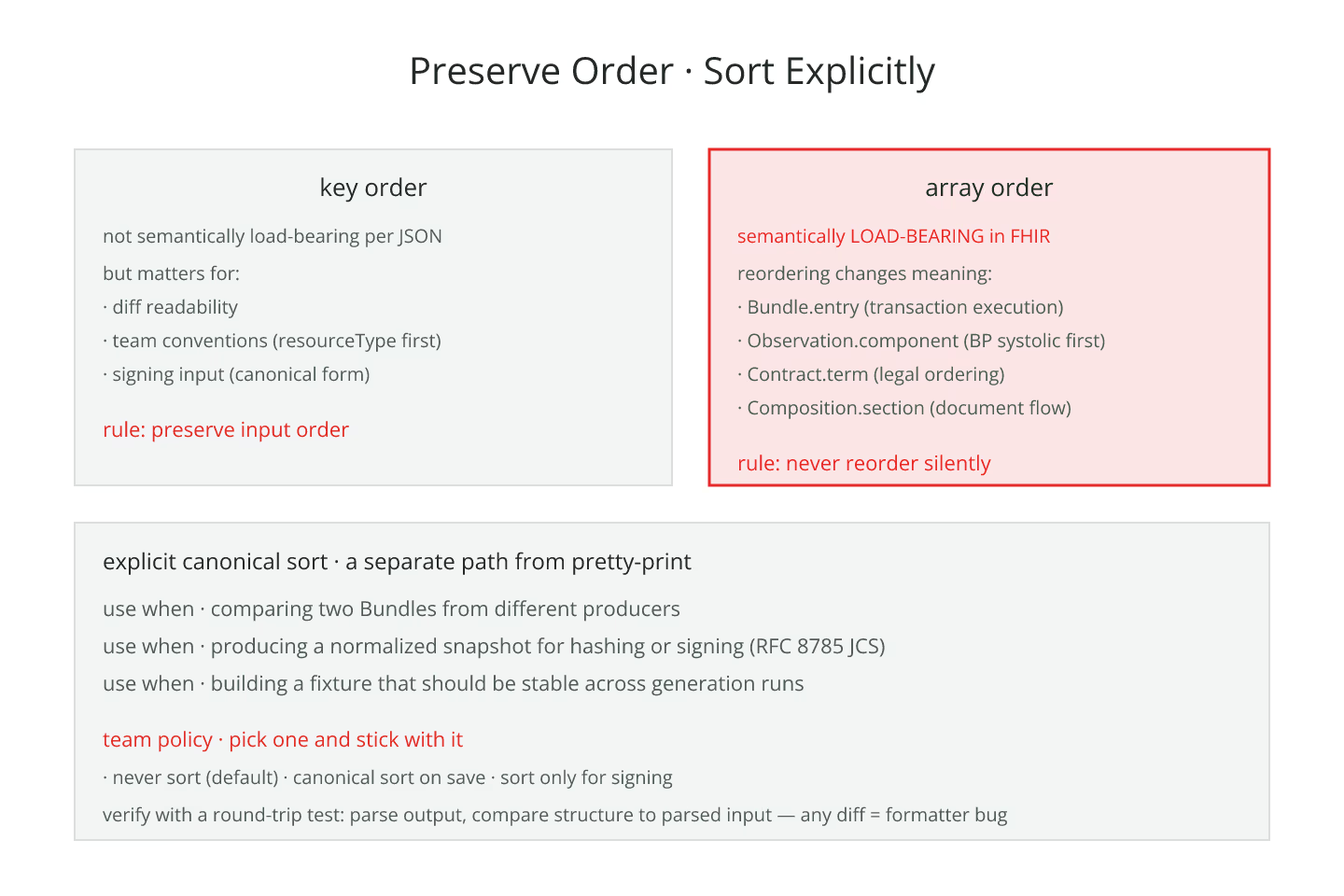
Key order is not semantically load-bearing per the JSON spec, but it matters for readability and diffs. Array order is semantically load-bearing in FHIR — Bundle.entry order matters for many workflows, Observation.component order can matter for panels, Contract.term order preserves legal meaning.
The Default Rule
Pretty-print without reordering anything. Whitespace changes; positions do not.
For the diff mechanic that depends on this, diff-friendly formatting for Bundles under version control is the entry.
When Explicit Sort Is Useful
- Comparing two Bundles that arrived from different producers — sort by
resourceTypeandidfor canonical form - Producing a normalized snapshot for hashing or signing
- Building a fixture that should be stable across generation runs
Every one of these is a case where the sort is an explicit, documented step. Not a formatter default.
Bundle.entry Order Is Load-Bearing
Servers process transaction Bundles in the order the client specifies. Search-result Bundles carry an order that matches the sort parameter. Message Bundles are strictly ordered. Reordering Bundle.entry silently is one of the more consequential formatter bugs.
For the reference implications, keeping references intact after pretty-printing is the entry.
Component Order Matters On Some Resources
Observation.component— blood pressure has systolic first then diastolic by conventionContract.term— order preserves legal semanticsComposition.section— order defines document flowQuestionnaire.item— order defines UI rendering
Reordering these produces payloads that validate but present differently.
Sort By Key With Care
Sorting keys alphabetically produces a canonical form useful for hashing but jarring to read. resourceType conventionally appears first, not sorted between note and subject. A key sorter that respects convention (resourceType, id, then alphabetical rest) reads better.
The tidier offers a "canonical sort" option that follows this convention. For the base pattern, why an unformatted Bundle costs you more time than a formatted one covers the format-first argument.
Signing And Hashing Need Explicit Canonical Form
Digital signatures and payload hashes require a canonical form — same input always produces the same byte sequence. Pretty-printing is not that form; canonical JSON with sorted keys and no whitespace is.
If your workflow includes signing, use RFC 8785 (JCS) canonical form for signing input, and format for humans separately. Do not conflate the two.
Verification After Pretty-Print
A well-written formatter can be verified: parse the output, compare to parsed input. If any structural difference exists, the formatter changed semantics. That check catches formatter bugs early.
Never trust a formatter you have not verified on your payloads.
Team Handling Of Sort
Pin the team's sort policy. Options:
- Never sort — default, preserve original order
- Canonical sort on save — every commit uses the same order
- Sort only for signing — signing pipeline sorts, editing does not
Each is defensible. Mixing them silently is not. For the conventions side, formatting conventions your team should pin down is the entry.
The Short Version
Pretty-print without reordering. Sort explicitly when the workflow needs a canonical form. Never let a formatter reorder Bundle.entry, Observation.component, or Contract.term silently. Verify the formatter round-trips your payloads without semantic change.
Sources
- HL7 canonical FHIR Bundle resource specification with entry - HL7 canonical FHIR Bundle resource specification with entry order semantics