

Reusable FHIR Store vs Point CMS-0057-F Solution: How Payers Should Choose in 2026
Have you started sketching the architecture for CMS-0057-F yet, or are you still waiting for a vendor short-list to land on your desk? The Jan 1, 2027 enforcement date is close enough that the choice is no longer abstract, and the shape of the choice is basically two camps. You either build on top of a reusable FHIR store, or you buy a point solution that only does CMS-0057-F.
Both camps ship code that passes the same Da Vinci implementation guides. The difference shows up in year three, not year one. If you want to compare the two options against your own team shape and roadmap, the conecion healthcare data hub has a lot of the background reading you will want first.
What Each Camp Actually Ships
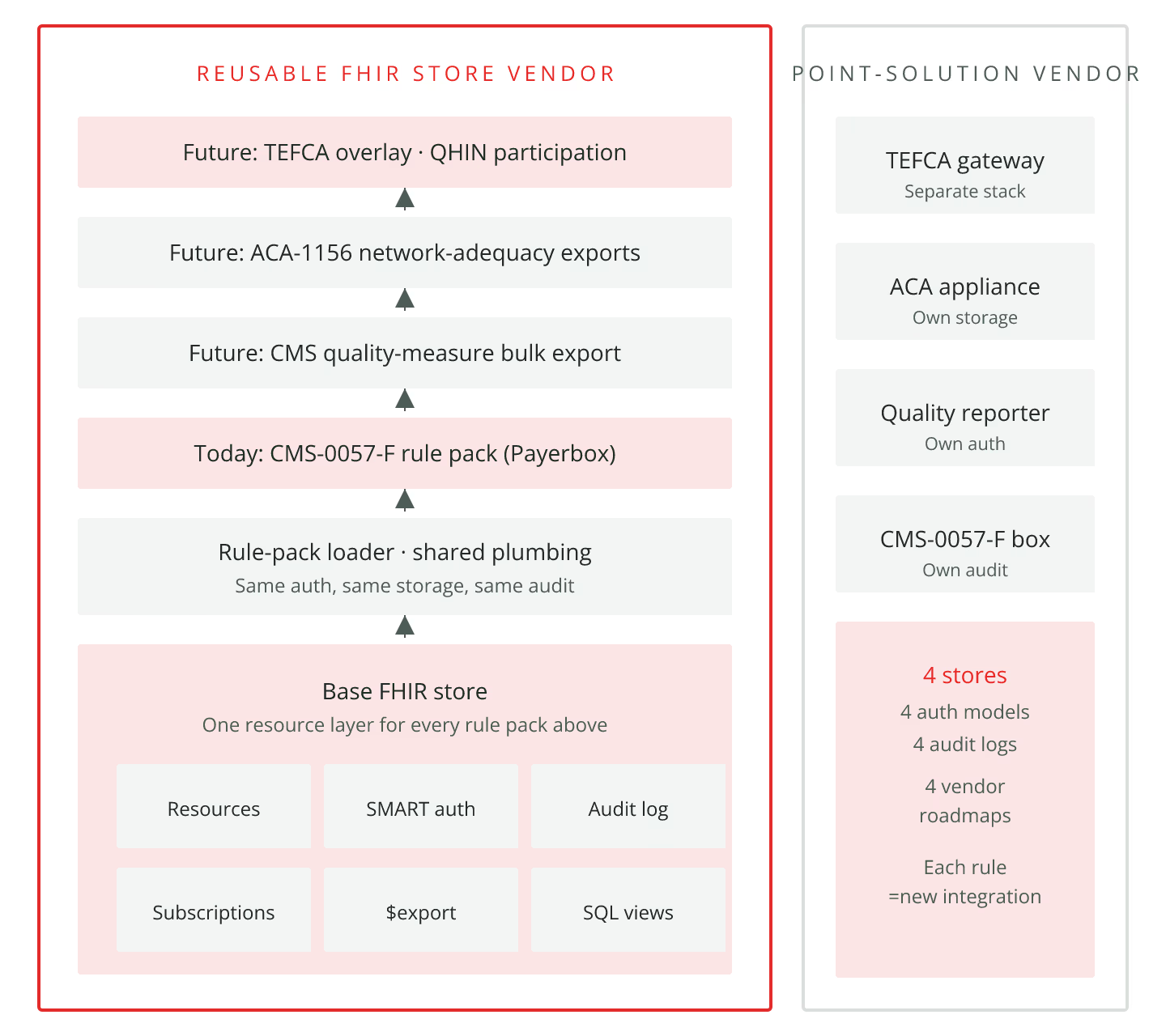
The reusable FHIR store camp gives you a general-purpose FHIR server (Aidbox, Smile CDR, Firely Server, HAPI) and layers CMS-0057-F on top as a compliance module or a set of profiled endpoints. The FHIR store is the primary asset. The four required APIs (Patient Access, Provider Access, Payer-to-Payer, Prior Authorization) become configurations on it.
The point solution camp (Onyx Health, Innovaccer, HealthLX, Availity Prior Auth) ships a purpose-built product that speaks CMS-0057-F and often little else. Under the hood there is still a FHIR store, but it is a black box you do not query for anything outside PA and Patient Access flows.
Data Model Reuse
If your roadmap has other FHIR use cases (member analytics, care gaps, HEDIS extracts, an internal member 360, digital front door) the reusable store keeps that data in one canonical place. You write Patient, Coverage, Claim, ExplanationOfBenefit resources once and every downstream app reads the same FHIR server.
A point solution keeps its data behind a compliance-only facade. You will typically end up with a separate lake or warehouse for anything outside CMS-0057-F, and then you get to reconcile two copies of the same member.
Cost Profile Over Five Years
Year one cost usually favors the point solution. It is faster to buy, faster to demo, and the vendor absorbs a lot of IG-tracking effort. By year three the picture flips for most payers because:
- You have paid for a FHIR store you cannot repurpose for anything else
- IG updates (PDex, PDex Plan-Net, CRD, DTR, PAS) roll through as new SKUs
- Any adjacent project (member portal, digital ID card, provider directory refresh) needs its own stack
- Renewal negotiations happen with a vendor whose product you cannot swap out without redoing the whole compliance layer
The reusable store camp trades more upfront engineering work for a shared substrate. If you already have Aidbox as your FHIR store, Payerbox packages the CMS-0057-F obligations as configurable modules on top, which sidesteps the second-platform decision entirely.
Dependency Risk
Point solutions concentrate risk on one vendor's roadmap. If HealthLX or Availity deprioritizes a Da Vinci IG version you need, your options are limited. Reusable stores spread that risk because the FHIR core and the compliance layer are separately swappable, and the FHIR core has many other tenants pushing the same fixes.
That said, the reusable path assumes you have or can hire FHIR-literate engineers. Which brings us to staffing.
Staffing Model
Point solutions fit teams that treat CMS-0057-F as a compliance line item and want a vendor to own it. You need product managers who can write policy and QA testers who can run PAS conformance suites. You do not need FHIR resource modelers on staff.
Reusable stores fit teams that already run (or plan to run) FHIR for other workloads. The same people who model your Coverage resources for member analytics can model them for the Patient Access API. If your PA workflows use DTR Questionnaires, the same folks who wrote the FHIR form builders playbook will run DTR too.
How to Pick
The decision is less "which is best" and more "which fits your operating model in 2026." Pick a point solution when CMS-0057-F is your only FHIR project, the compliance date is your only pressure, and your engineering bench is thin. Pick a reusable FHIR store when you already run FHIR workloads, have three or more use cases queued up, or when your budget planning horizon runs past 2028. If you land on the reusable path but are new to running a FHIR server in production, our writeup on cloud-native vs self-hosted FHIR engines walks through the operational tradeoffs before you commit.
Sources
- HTML, HL7 Da Vinci, current build — Payer Data Exchange (PDex) IG v2.2.0 covering Patient Access, Provider Access and Payer-to-Payer flows on reusable FHIR
- PDF, CMS, 2024 — Advancing Interoperability and Improving Prior Authorization Processes Final Rule (CMS-0057-F) canonical text
- PDF, CMS, 2024 — Fact sheet detailing the four required FHIR APIs and compliance dates