
Best Terminology Servers for FHIR-Native Decision Support in 2026
FHIR-native decision support has a specific relationship with the terminology layer. Every CQL expression that walks a SNOMED hierarchy, every quality measure that checks ValueSet membership, every CDS Hooks call that needs subsumption: all of them depend on the terminology server staying fast and accurate. A FHIR terminology server tuned for decision support is a different shape from one tuned for general lookup.
Below are the terminology servers that fit the decision-support workload well in 2026. The broader picture lives in the complete guide to FHIR terminology services for modern healthcare, and the broader FHIR coverage on this site covers the related decision-support tools.
What Decision Support Needs
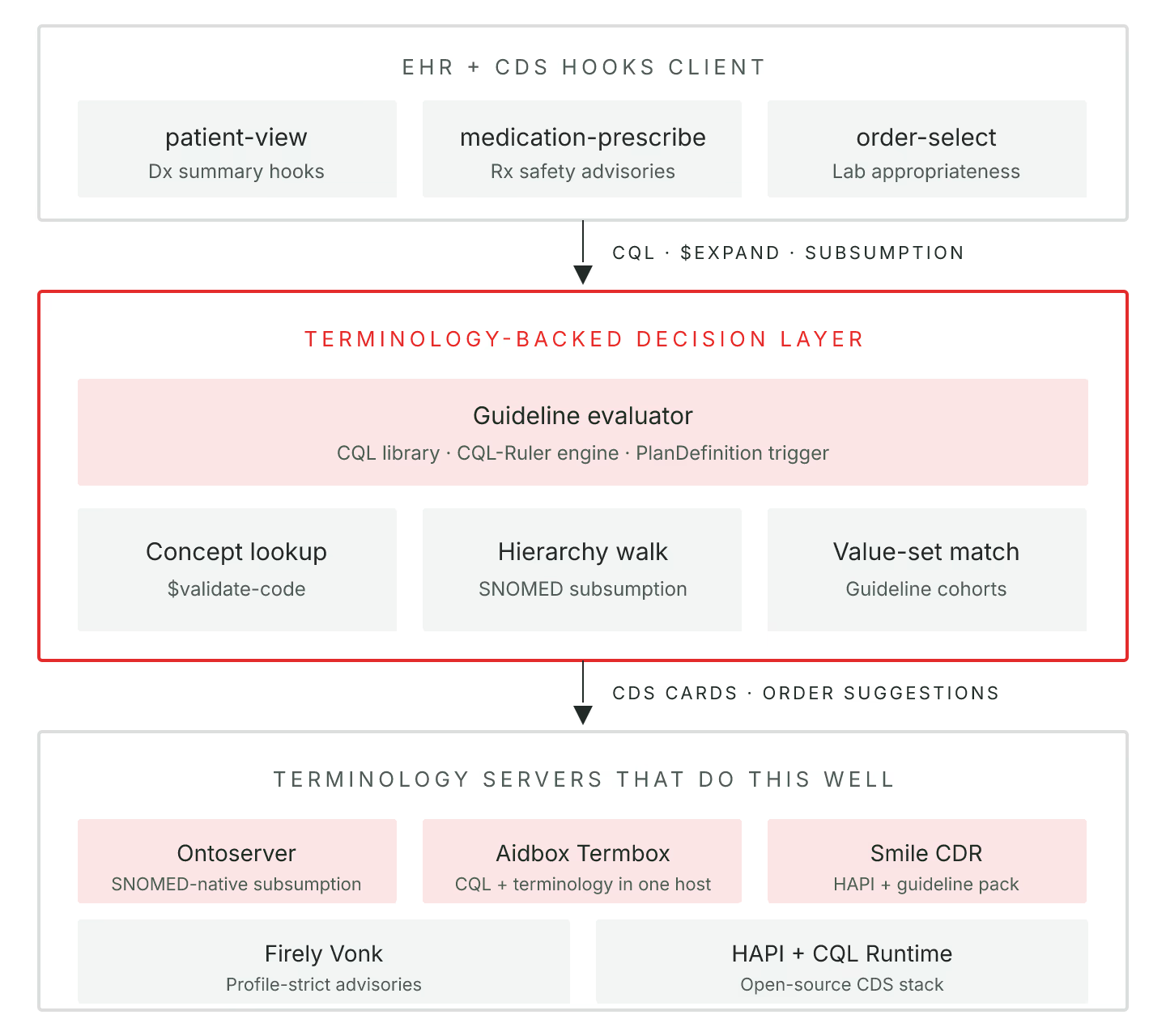
Three properties matter most for decision-support workloads:
- Reliable subsumption (
$subsumes). CQL expressions and CDS logic both depend on hierarchy traversal being correct and predictable. - Fast
$expandfor ValueSets that drive measure logic. Quality measures expand the same ValueSets repeatedly; caching helps a lot. - Strong version handling. Decision support that depends on terminology cannot tolerate drift mid-shift. The server has to pin the response to a specific version.
A FHIR terminology server that handles those three is a much smoother fit for decision-support stacks.
The Terminology Servers Worth Considering
- Snowstorm. Strong subsumption and
$expandfor SNOMED-heavy decision support. The natural pick when most of the CQL traverses SNOMED CT hierarchies.
- Ontoserver. Commercial terminology server with broad code system support and strong defaults for the decision-support workload, including telemetry.
- Aidbox Terminology. Server-side terminology operations next to the FHIR store, which keeps round trips small for the CDS service. Strong cache behavior on repeated ValueSet expansions.
- HAPI Terminology paired with a CQL engine. Reliable as the terminology layer when the CQL execution sits in a separate engine that calls in.
- Firely Server Terminology. Strong on profile-driven ValueSets that are bound to specific implementation guides. Fits decision support tied to a particular IG.
For the real-time CDS Hooks lens specifically, the best terminology tools for real-time CDS Hooks covers the latency-sensitive case in more detail.
Patterns That Make Decision Support Reliable
A few patterns that hold up:
- Pin the code system version in every CQL expression. Implicit "latest" is a known source of intermittent failure.
- Precompute the expansion of high-traffic ValueSets and cache the result.
- Build a regression test that runs the CQL against a known terminology version. Run it on every release.
- Track unmapped codes. The decision-support layer often degrades silently when it sees a code it cannot validate.
A Quick Decision-Support Bake-Off
A short test for any candidate FHIR terminology server in a decision-support context:
- Run the team's most-used CQL expression against the server. Time it.
- Bump the SNOMED version and rerun. Look for behavior changes.
- Run a load test that matches shift-change concurrency. Watch p99.
- Inject a value the server has not seen and observe how the CDS layer handles it.
- Audit one full day of lookups and confirm the logs include enough detail for compliance review.
A FHIR terminology server that handles all five steps cleanly is a strong candidate for the decision-support layer. One that fails the version-bump or unknown-value test usually creates a category of clinical risk that is hard to fix later.
Decision support is one of the workloads where the right FHIR terminology server makes the rest of the system feel reliable. Pick it based on the real CQL workload and the rest of the clinical decision layer tends to settle into place.
Sources
- canonical CDS Hooks specification - HL7 CDS Hooks v2.0.1
- Terminology Service specification (decision-support baseline) - HL7 FHIR R6
- Implementation of HL7 FHIR-Based Terminology Services (peer-reviewed) - PubMed 2025